


AI-powered warehouse management for smarter, faster, and more efficient warehouse operations.
Warehouses have evolved far beyond simple storage facilities. Today, they are strategic hubs that directly influence inventory accuracy, order fulfillment, supply chain efficiency, and customer satisfaction.
As businesses manage more SKUs, higher order volumes, multiple sales channels, and increasingly complex supply chains, traditional warehouse processes can become difficult to manage. Manual inventory updates, inefficient picking routes, misplaced stock, delayed reporting, and disconnected systems can all increase operational costs.
This is where an AI Warehouse Management System can transform warehouse operations.
An AI-powered WMS combines warehouse management software with real-time data, intelligent automation, analytics, and AI-driven decision-making. Instead of simply recording warehouse activities, it helps businesses understand what is happening inside the warehouse and make smarter operational decisions.
What Is an AI Warehouse Management System?
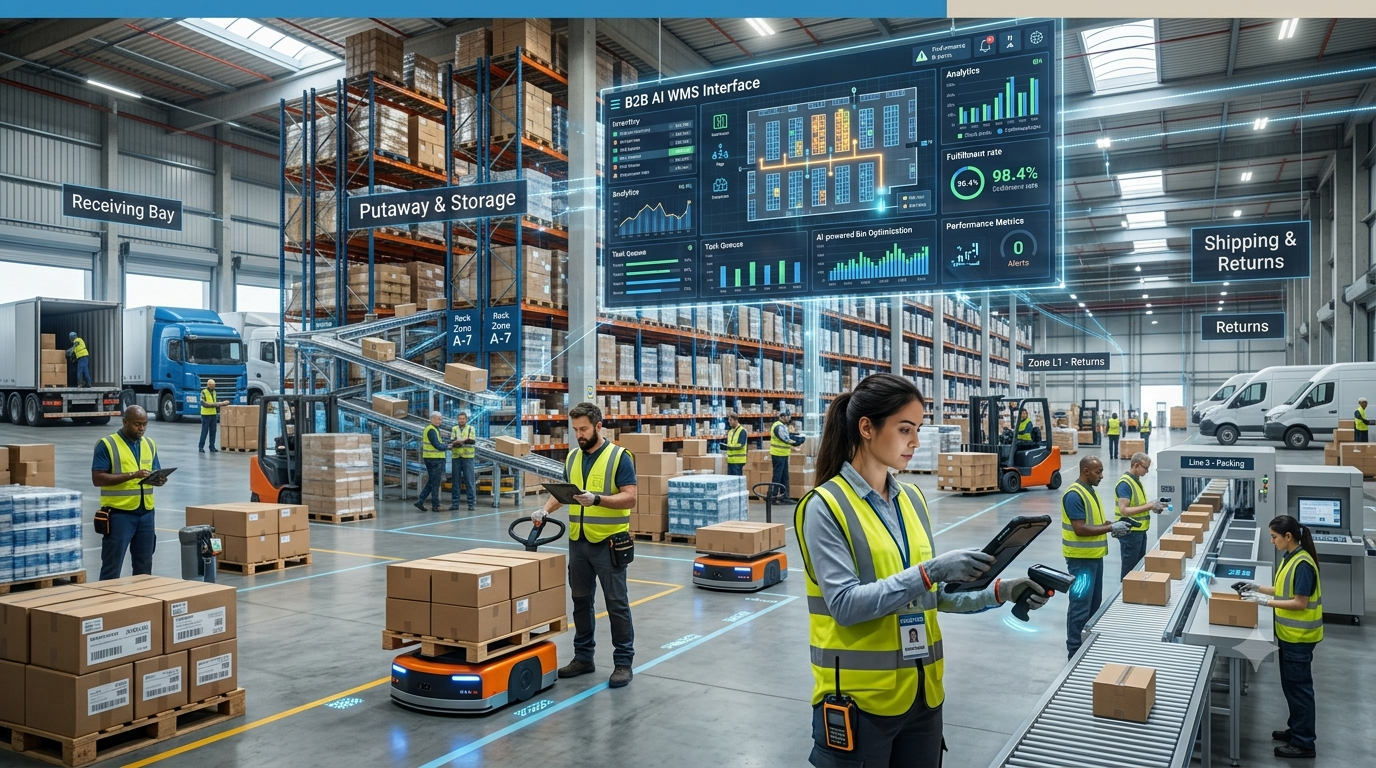
AI-powered Warehouse Management System for intelligent inventory and warehouse operations.
An AI Warehouse Management System (WMS) is a technology platform that uses artificial intelligence, real-time inventory data, automation, and intelligent workflows to manage and optimize warehouse operations.
A traditional warehouse management system typically manages processes such as:
- Receiving
- Putaway
- Storage
- Inventory tracking
- Replenishment
- Picking
- Packing
- Shipping
- Returns
An AI Warehouse Management System takes these processes further by using data and intelligence to optimize how warehouse activities are performed.
For example, AI can help businesses identify better storage locations, provide intelligent bin-placement recommendations, optimize picking workflows, identify exceptions, and improve inventory visibility.
The goal is simple: make warehouse operations faster, more accurate, more connected, and easier to scale.
Why Businesses Are Moving Toward AI-Powered WMS
Warehouse operations are becoming increasingly complex.
An organization may have:
- Thousands of SKUs
- Multiple warehouses
- Multiple sales channels
- High order volumes
- Different inventory categories
- Expiry-sensitive products
- Multiple logistics partners
- ERP and e-commerce systems
- Large teams of warehouse operators
Managing all of this manually can create operational bottlenecks.
Common problems include:
Poor Inventory Visibility
Warehouse teams may not always know the exact quantity or location of inventory.
This can result in stock discrepancies, delayed fulfillment, overselling, and unnecessary inventory purchases.
Inefficient Picking
When operators spend excessive time searching for products or walking between storage locations, fulfillment becomes slower and more expensive.
Manual Data Entry
Paper-based processes and repetitive data entry can increase errors and make reporting slower.
Disconnected Systems
When ERP, e-commerce, warehouse, and logistics systems do not communicate effectively, teams may have to enter the same information multiple times.
Difficulty Scaling
A process that works for one warehouse may become difficult to manage when a business expands to multiple sites.
An AI-powered WMS helps address these challenges by connecting warehouse processes, inventory information, operators, and business systems through a centralized platform.
How an AI Warehouse Management System Works
An AI WMS connects physical warehouse activities with digital intelligence.
A typical process may look like this:
Receive → Put Away → Store → Replenish → Pick → Pack → Ship → Deliver
At each stage, the system can capture operational information and use it to improve the next action.
For example:
- Inventory arrives at the warehouse.
- Products are scanned during receiving.
- The system verifies the inventory.
- Intelligent rules determine an appropriate storage location.
- Inventory becomes visible at the bin level.
- Replenishment alerts are generated when required.
- Operators receive guided picking instructions.
- Products are scanned and verified.
- Orders are packed and shipped.
- The entire process is recorded for reporting and traceability.
Warewiser follows this connected approach across the warehouse lifecycle, including receiving, putaway, storage, replenishment, picking, packing, shipping, and delivery.
Key Benefits of an AI Warehouse Management System
1. Real-Time Inventory Management
One of the biggest advantages of modern warehouse management software is real-time inventory visibility.
Instead of relying on periodic stock counts or spreadsheets, warehouse teams can monitor inventory as transactions occur.
Real-time inventory management can provide visibility into:
-
- Current stock levels
-
- Product locations
-
- Bin-level inventory
-
- Damaged stock
-
- Expiring inventory
-
- Inventory aging
-
- Low-stock situations
-
- Warehouse exceptions
Warewiser provides live bin-level inventory visibility, with stock positions updated through operator scans.
This gives managers a more accurate view of what is actually available inside the warehouse.
2. AI-Powered Warehouse Optimization
Warehouse space is valuable.
Poor inventory placement can increase travel time, congestion, and picking costs.
AI can analyze inventory movement and warehouse conditions to help determine better storage locations.
For example, frequently picked products can be positioned in locations that are easier and faster for operators to access.
This can help businesses improve:
-
- Space utilization
-
- Picking efficiency
-
- Operator productivity
-
- Warehouse throughput
-
- Order fulfillment speed
Warewiser uses AI-driven bin optimization and bin-level placement recommendations as part of its warehouse intelligence capabilities.
3. Faster and More Accurate Picking
Picking is one of the most important warehouse activities because it directly affects order fulfillment.
A warehouse management system can guide operators through picking tasks rather than relying entirely on manual decision-making.
With scanner-based workflows, operators can:
-
- Identify the correct product
-
- Confirm quantities
-
- Follow guided picking instructions
-
- Reduce wrong-item picks
-
- Update inventory immediately
Warewiser supports FIFO and FEFO guided picking through RF handheld workflows, helping operators follow system-directed picking processes.
The result can be a more consistent and controlled picking process.
4. Better Warehouse Automation
Warehouse automation does not necessarily mean replacing warehouse employees with robots.
In many operations, automation means eliminating repetitive manual activities and allowing technology to guide operators.
Examples include:
-
- Automated replenishment alerts
-
- Barcode scanning
-
- System-directed putaway
-
- Guided picking
-
- Automatic inventory updates
-
- Exception alerts
-
- Automated reporting
-
- Carrier integrations
AI adds another layer by helping the system determine what action may be more efficient based on available operational data.
This combination of automation + intelligence can make warehouse operations significantly more responsive.
5. Improved Inventory Accuracy
Inventory accuracy is critical for any business that stores and fulfills physical products.
If the system shows that an item is available but the warehouse cannot locate it, the business may experience:
- Delayed orders
- Wrong shipments
- Customer complaints
- Stockouts
- Overselling
- Additional operational costs
Scan-based warehouse workflows can help ensure that inventory movements are recorded at each operational touchpoint.
Warewiser’s platform is designed around scan-confirmed warehouse workflows and real-time inventory updates.
6. Real-Time Operational Intelligence
A modern warehouse needs more than raw data.
Managers need actionable information.
An AI-powered WMS can help identify:
- Inventory exceptions
- Slow-moving products
- Low-stock situations
- Expiring inventory
- Damaged stock
- Operational bottlenecks
- Picking performance
This allows warehouse managers to focus on problems that require attention instead of manually reviewing large amounts of data.
Warewiser provides role-based dashboards, exception alerts, and inventory-aging visibility to support operational decision-making.
7. Multi-Warehouse Management
As businesses expand, they may operate multiple warehouses across different cities or regions.
Managing each warehouse independently can create fragmented information.
A scalable AI Warehouse Management System can provide centralized visibility across:
- Multiple warehouses
- Multiple sites
- Multiple zones
- Different inventory categories
- Different operational teams
Warewiser is designed to support multi-site, multi-warehouse, and multi-zone operations through a single platform.
This can help businesses maintain consistent processes while expanding their warehouse network.
8. Seamless Business System Integration
A warehouse does not operate independently.
It typically needs to exchange information with:
- ERP systems
- E-commerce platforms
- Logistics providers
- Barcode scanners
- RFID systems
- Cloud platforms
- Business intelligence tools
Without integration, businesses may need to manually transfer information between systems.
Modern warehouse management software can create a connected technology ecosystem.
Warewiser currently lists integrations across ERP, e-commerce, logistics, hardware, cloud, analytics, and developer APIs. Its integration catalog includes systems and technologies such as SAP Business One, Microsoft Dynamics, Shopify, WooCommerce, Zebra, Honeywell, FedEx, DHL, AWS, Azure, and Power BI.
AI Warehouse Management System for Different Industries
Different industries have different warehouse requirements.
A flexible WMS should therefore support industry-specific workflows.
Retail and D2C
Retail and D2C businesses often deal with:
- Large SKU catalogs
- High order volumes
- Multiple sales channels
- Fast-moving inventory
- Same-day fulfillment requirements
An AI-powered WMS can help improve inventory visibility and fulfillment efficiency.
Manufacturing
Manufacturers need to track:
-
- Raw materials
-
- Work-in-progress inventory
-
- Finished goods
-
- Production-related inventory movements
A WMS can help provide better traceability across the warehouse and production environment.
Pharma and Life Sciences
Pharmaceutical and life-science warehouses require strict inventory control.
Important capabilities can include:
-
- Batch tracking
-
- Lot management
-
- Expiry management
-
- FEFO
-
- Audit trails
Warewiser provides workflows for lot, batch, and expiry control for regulated goods.
3PL Logistics
Third-party logistics providers manage inventory for multiple customers.
This creates additional requirements such as:
-
- Multi-client inventory
-
- Multiple warehouses
-
- Customer-specific workflows
-
- SLA management
-
- Operational visibility
A scalable WMS can help 3PL providers manage these requirements from a centralized platform.
Cold Storage
Cold-storage operations require careful management of temperature-sensitive and perishable inventory.
Warehouse systems can support temperature-zoned putaway and FEFO-based picking.
Warewiser specifically lists cold storage as a supported industry with temperature-zoned putaway and FEFO picking workflows.
AI WMS vs Traditional Warehouse Management Software
The biggest difference between traditional warehouse management software and an AI-powered WMS is the level of intelligence applied to warehouse data.
| Traditional WMS | AI-Powered WMS |
|---|---|
| Records warehouse activities | Analyzes warehouse activities |
| Provides inventory data | Provides real-time inventory intelligence |
| Rule-based workflows | Intelligent workflow optimization |
| Basic reporting | Actionable dashboards and insights |
| Manual exception identification | Automated exception alerts |
| Static inventory placement | AI-supported bin optimization |
| Separate operational processes | Connected end-to-end workflows |
The objective is not simply to digitize the warehouse.
It is to make the warehouse more intelligent and responsive.
What to Look for in an AI Warehouse Management System
Before selecting a warehouse management platform, businesses should evaluate several important factors.
Real-Time Inventory Visibility
The system should provide accurate inventory information across locations and bins.
Intelligent Warehouse Optimization
Look for capabilities that can improve storage, picking, replenishment, and resource utilization.
Mobile and Scanner Support
Warehouse operators need technology that works on the warehouse floor.
Integration Capabilities
The WMS should integrate with the systems already used by the business.
Scalability
The platform should support growth from one warehouse to multiple warehouses.
Security
Businesses should evaluate authentication, access control, encryption, and audit capabilities.
Industry-Specific Workflows
A WMS should be flexible enough to support the specific requirements of the industry.
Warewiser, for example, highlights mobile support for Zebra, Honeywell, Motorola, iOS, and Android devices, along with role-based access, SSO/MFA, encryption, and audit trails.
How Warewiser Helps Build Smarter Warehouse Operations
Warewiser is an AI-powered Warehouse Management Platform designed to connect inventory, warehouse workflows, operators, and business systems.
Its platform focuses on areas including:
- AI-driven bin optimization
- Real-time inventory visibility
- Intelligent workflows
- Inventory aging
- Exception alerts
- Mobile and scanner-based operations
- FIFO and FEFO picking
- Multi-site warehouse management
- ERP and e-commerce integrations
- Enterprise security
Warewiser states that its platform supports 20+ integrations and is designed to scale across multiple warehouses and sites.
The platform also covers the complete warehouse lifecycle, from receiving and putaway to picking, packing, shipping, and delivery.
For businesses looking to move beyond spreadsheets and disconnected warehouse processes, an AI-powered WMS can provide a more connected approach to warehouse management.
The Future of Warehouse Management Is AI-Powered
The future of warehousing is not simply about storing more products or processing more orders.
It is about making better decisions with the data generated by every warehouse movement.
As businesses grow, they need greater visibility, faster fulfillment, improved inventory accuracy, and scalable operations.
An AI Warehouse Management System can help businesses move toward this future by combining:
-
- Artificial intelligence
- Real-time inventory management
- Warehouse automation
- Intelligent workflows
- Data-driven decision-making
- Mobile warehouse operations
- System integrations
- Multi-warehouse scalability
The result is a warehouse that is not only digitally connected but also capable of responding intelligently to changing operational conditions.
Conclusion
Warehouse management is becoming increasingly complex, and traditional processes may not provide the speed, visibility, and flexibility modern businesses require.
An AI Warehouse Management System can help organizations transform warehouse operations by improving inventory visibility, optimizing warehouse space, supporting faster picking, reducing manual work, and connecting warehouse operations with the wider supply chain.
Whether you operate a D2C warehouse, manufacturing facility, 3PL operation, distribution center, pharma warehouse, or cold-storage facility, choosing the right warehouse management software can play an important role in improving operational efficiency.
The key is to choose a platform that does more than track inventory.
Choose technology that helps your warehouse make smarter decisions.
Ready to Make Your Warehouse Smarter?
Explore how Warewiser can help you improve inventory visibility, optimize warehouse workflows, and build a more intelligent warehouse operation.
Request a personalized Warewiser demo and see how the platform can work with your real warehouse workflows and inventory.
FAQ
What is an AI Warehouse Management System?
An AI Warehouse Management System is software that combines traditional warehouse management capabilities with artificial intelligence, real-time data, automation, and intelligent workflows to improve warehouse operations.
What are the benefits of an AI-powered WMS?
An AI-powered WMS can help improve inventory visibility, warehouse optimization, picking efficiency, operational intelligence, automation, and decision-making.
How does AI improve warehouse management?
AI can analyze warehouse data and support decisions related to inventory placement, picking, replenishment, exception management, and operational optimization.
Can an AI WMS manage multiple warehouses?
Yes. Modern scalable WMS platforms can provide centralized visibility and management across multiple warehouses, sites, and zones.
Can a WMS integrate with ERP and e-commerce platforms?
Yes. Modern WMS platforms can integrate with ERP, e-commerce, logistics, hardware, cloud, and analytics systems. Warewiser currently offers multiple pre-built integrations and API capabilities.
Is an AI WMS suitable for 3PL companies?
Yes. AI-powered WMS platforms can support multi-client inventory, multi-warehouse operations, customer-specific workflows, and logistics requirements, making them suitable for many 3PL operations.
What is the difference between WMS and AI WMS?
A traditional WMS primarily manages and records warehouse processes. An AI WMS adds intelligence, automation, real-time analysis, and optimization capabilities to help businesses make better operational decisions.
How can I choose the right AI Warehouse Management System?
Evaluate the platform’s inventory visibility, AI capabilities, warehouse workflows, integrations, mobile support, scalability, security, industry-specific features, implementation process, and overall business requirements.